

 LinkedIn
Your logo doesn’t ship the work
Most white-label AEO platforms sell agencies monitoring, then leave the agency to do the work. Technical fixes, content, publishing, citation outreach: all yours. It is the 1am negative-keyword-mining problem moved to AEO and sold at a markup.
I keep seeing the same demo. An account executive uploads an agency logo, chooses a hex code, and clicks “generate PDF.” Buy the software for a couple hundred dollars a month, the pitch goes, put your branding on the portal, mark it up to $1,500 on an agency retainer, and pocket the margin while AI handles the work. About twelve minutes in, the catch becomes clear. The software has built a fresh queue of tasks for your junior account managers to drown in at 10 PM.
Watch where the demo slows down. There is time to show the client view, the colors, the export, and the graph that moves when a prompt is added. Ask who changes the client’s site when that graph moves the wrong way, and the answer gets less crisp. A recommendation is easy to display. Getting it through review, onto the site, and into the next round of measurement is the part the agency sells.
I know the rhythm from paid search. You buy a tool that promises account hygiene; it alerts you to thirty-four problems it has no intention of solving. Now the dashboard tells you a client lost citations in ChatGPT for high-intent category queries. A competitor was quoted in Perplexity. Citation share has declined for ninety days. Lovely chart. Then it waits for your team to write twelve articles, rewrite five product schemas, fix crawler access in robots.txt, and pitch third-party publishers for brand mentions.
That is not white-label fulfillment. That is white-label homework.
The margin calculation leaves out your payroll
“Actionable insights” become tickets for your team
The sales math relies on one omission: your agency’s labor costs do not disappear because the work arrives in a dashboard. The agency calculator published by Ayzeo, for example, puts 10 clients on $1,000 monthly retainers at $9,508 after a $492 monthly software bill, including its $149 base fee, per-client fees, and $299 to enable client-facing dashboards. That looks like a fat margin if nobody has to fulfill the retainers. As Inflowave’s breakdown of white-label fulfillment points out, software pitches can make margins look enormous by ignoring the internal labor required to deliver the service.
That missing labor is not a small-print expense. Every gap the tool finds needs someone to decide whether it matters, get approval if it does, do the work, and check that the change went live. The calculator subtracts the software bill because the vendor knows what it charges. It cannot subtract the hours your team will spend turning its alerts into a service.
The subscription does not deliver the retainer. It gives you permission to bill for work your staff has not yet performed.

“Content recommendations” still need a writer and an editor
Open the dashboard on Monday. An ecommerce client has lost share of voice in ChatGPT because two competitor buying guides were cited instead. The platform flags the gap. It does not produce the 2,000-word comparative guide, verify its technical specifications, or push the page live. As an industry review from SearchEye observed, white-label AI visibility tools can surface citation gaps while leaving content creation and PR outreach to agencies.
Your account lead now writes a brief, books an outsourced writer at $0.25 a word, and spends four hours editing so the client does not get embarrassed. At that rate, the writer alone costs $500 for a 2,000-word piece. Editing, client review, and CMS formatting still sit on top of it. That $1,000 retainer did not come with the margin the sales slide implied.
And the dashboard does not make the editorial decisions. A comparative guide needs to answer the category question the client actually cares about, not merely contain the phrases the monitoring tool highlighted. Someone has to check the claims against the client’s product, keep the page useful, and decide when it is ready to represent the brand. Calling that last stretch “minor cleanup” does not make it free.
The client logs into a custom-domain portal like the one offered by LLM Pulse, sees your logo, and asks why visibility has not moved. The vendor has collected its subscription fee. You are explaining why a four-figure retainer bought thirty graphs and one published article.
“Technical audit” still needs someone who can make the fix
The portal’s next tab crawls the site, flags 412 issues, and drops a CSV in your lap. An issue count is not an execution plan. As practitioners in Reddit’s SEO discussions point out, automated audits can lack operational judgment: missing alt text on an old author avatar gets the same crimson warning as a robots.txt rule blocking GPTBot or missing Schema on a primary revenue page.
The platform assumes an idle developer can patch edge servers, configure DNS redirects, and deploy structured JSON-LD for an $800 retainer. You may not have one. Your account manager spends three hours filtering the export in Google Sheets, discards 350 irrelevant warnings, and leaves the remaining sixty untouched because nobody on the team knows how to edit the client’s custom headless Shopify theme.
This is where the phrase “technical audit” does some suspiciously heavy lifting. Finding an issue tells you where to look. Prioritizing it tells you what to do first. Deploying the fix changes the site. Those are different jobs, and only the last one resolves the warning the client is paying you to address. If your team cannot do it, a larger CSV has not helped.
The alert was automatic. The fix was not.
The software bill is only the first bill
Prompt caps make testing more expensive; draft tools can stop at draft
You are not buying an outcome when the product charges for tracking credits. Geoptie’s agency pricing breakdown describes entry tiers around $99 a month capped at five client projects and twenty tracked prompts each. Run an active roster tracking forty category queries across ChatGPT, Claude, and Perplexity, and the bill can climb into four figures. As I wrote in my look at how agencies are restructuring AEO retainers, prompt caps penalize the agency for testing real search behavior.
That creates an odd incentive. The more seriously you try to understand what buyers see across engines and queries, the more credits you consume. Meanwhile, knowing that a citation gap exists still does not fill it. You can spend more to watch the problem from additional angles while the same unfinished article waits in the editor.
Adding an AI content agent does not necessarily close the gap. Some white-label platforms offer draft-generation features for another monthly charge, as Indexly’s platform rundown notes. A draft in an internal editor is not a published, verified page. If delivery stops there, your team still has to check statistics, format markup, source images, enter the client’s Webflow instance, and hit publish.
So you pay for the seat, pay for the prompts, and pay your staff to be a human copy-paste bridge. What the deck calls leverage, I call another invoice attached to the same unfinished job.
The client sees your logo, not the vendor’s backlog
When an agency resells monitoring as fulfillment, the client does not get angry at the software vendor. They do not know the vendor exists. They know your agency took a $1,500 monthly retainer for “AI Search Optimization,” delivered thirty pages of charts, and failed to produce a new qualified lead or top-tier citation. As agency owners in Reddit’s agency community warn, reselling software without back-end delivery infrastructure can become an avalanche of support tickets.
Your account managers spend fifteen unbilled hours explaining why the graphs are not becoming pipeline, defending recommendations nobody had time to ship, and writing emergency blog posts on Sunday to appease a client who is ready to leave. The software vendor does not join that call. Its logo is not on the report.
This is why branding cannot be the test of a white-label partner. The custom domain determines who takes the complaint; it says nothing about who did the work. If the agency must supply the writer, editor, developer, publisher, and outreach, the vendor has not taken fulfillment off its plate. It has made the plate easier for the client to see.

Here is the trap: the vendor charges you a fixed fee to point out work while leaving the cost of doing it on your ledger. Real white-label fulfillment reverses that arrangement. Technical fixes, content production, CMS deployment, and citation-building work happen behind your brand; your team owns client strategy instead of routing tasks between a dashboard and a freelancer.
That is the operating model behind groas for agencies. Specialized AI models and senior strategists execute technical and content work on the client’s domains, with actions and rationale logged under your brand. Your account managers should be accountable for the client relationship, not hired as human middleware between an alert and a live page.
The agency that should buy the dashboard
If you already have the people to do the work, reporting software can be useful. A forty-person agency with in-house technical SEOs, two front-end developers waiting for sprint tickets, and a dedicated editorial team might only need prompt-tracking telemetry and a clean client-facing portal. Paying $299 a month for dashboards in your hex colors can make tactical sense when fulfillment capacity is already sitting there.
That agency knows what it is buying: a way to see and present the work, not a substitute for its delivery team. The distinction matters before the contract, not after the first month of client calls. If the people who can ship the fixes are already on payroll, a useful queue is a useful queue. Just do not call the queue fulfillment.
But if you are shopping for white-label AEO because you want to sell retainers without hiring four additional salaries, do not confuse telemetry with delivery. You are buying an automated queue of unpaid labor for the staff you already have.
Five questions before the next logo-upload demo
Before another salesperson shares a screen to show you SVG uploads and Looker Studio exports, take control of the call. My longer breakdown of the five questions to ask before you buy another dashboard gets at the same test: are you buying fulfillment, or an unstaffed chore list? Ask these in order. Do not let a chart answer for a person.
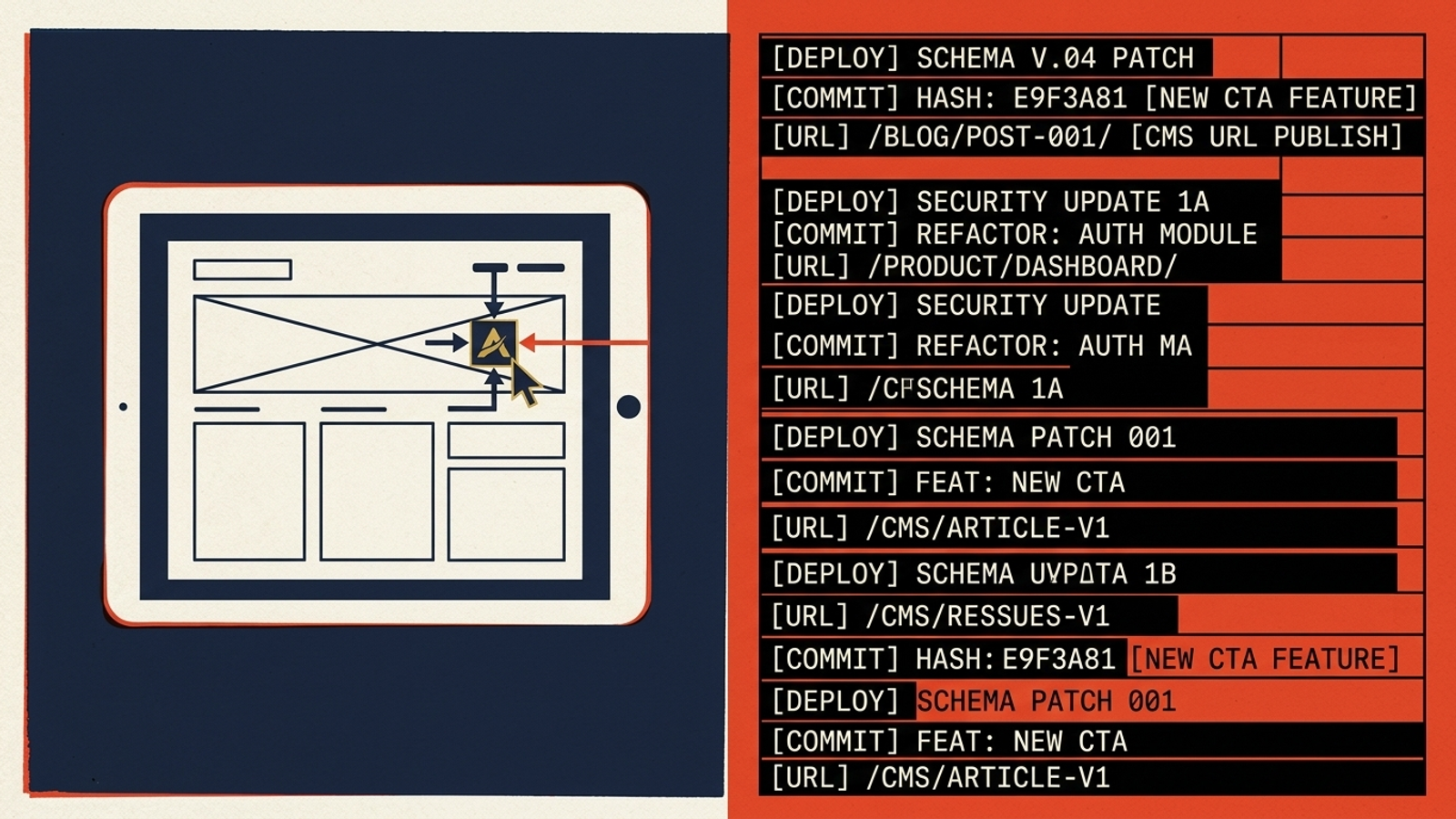
- Who pushes new content to the client CMS? An exported draft still needs formatting, assets, and a person to hit publish.
- Who deploys fixes when
robots.txt, redirects, or Schema break? An audit spreadsheet means you supply the developer. - Who secures citations on third-party domains? If nobody does, your team owns the outreach.
- Is pricing flat per domain or restricted by prompt quotas? Caps can make active, multi-engine testing expensive.
- What does the action log show after thirty days of live management? This is the item vendors skip most often. If it shows crawler timestamps and rank changes rather than deployed fixes and published URLs, the cost is another month of your team triaging work the platform never did.
Watch the answer to number five. If the rep pivots to Looker Studio templates or a “proprietary scoring algorithm,” close the tab. You came to see work completed, not a prettier account of work outstanding.
I have seen this before in PPC bidding software: a vendor charged a percentage of ad spend to flag wasted search terms that an account manager still had to negate by hand at midnight. The AEO version is no better. If a white-label partner cannot deploy the technical patch, write the verified category answer, publish the page, and build citations under your name without making your staff operate the keyboard, it is not delivering the service you thought you bought.
White-label should mean the work gets done under your brand, not that the report carries your logo. Stop paying for a dashboard that measures how far behind your team is.