

 LinkedIn
An ad can appear beside an AI answer that cites your competitor. A forecast about 2027 will not tell you whether that is happening on the searches that pay your bills.
I made five forecasts in Ads Are Moving Into AI Answers. Five Predictions for Organic Citations by 2027. We are taking a second look because you do not have to wait until 2027 to see whether they hold for your business. Industry averages describe the market. Your decision depends on what appears on your own commercial queries, and you can start measuring those this week.
Here is the test: on the searches that make you money, do AI Overviews carry ads, who gets cited inside them, and can a page change move you into the cited set? If you are cited beside the ad, defend that position and test what paid adds. If you are not, work on the citation before you raise bids.
Build a fixed list of searches that produce business
Start with 30 to 50 queries, written down before you check a single result. Split them roughly into four buckets:
- Direct commercial searches, such as
emergency plumber near meorsaas onboarding software pricing. - Comparisons, such as
hubspot vs pipedrive for small team. - Informational searches that precede a purchase, such as
how much does air duct cleaning cost. - The literal how-do questions buyers ask in your trade.
A fixed 20-to-50-query sample is what HubSpot’s measurement guide recommends for tracking Overview coverage over time. Without a stable sample, a change in the results could just be a change in the questions you asked.
Pull your list from places where money has already shown up: Search Console queries that produced clicks, your paid search term report sorted by spend, and the last month of sales call notes. I used to build these lists from keyword tools. I was wrong. Tools give you volume. Your term report gives you the 12 queries eating 60% of a $20k/month budget, and those are the ones where an ad inside the answer can change your CPA.
Freeze the list. Do not add an interesting new query halfway through and call it part of the same test. Put it on the list for the next run.
Hold the search conditions steady
Check every query logged out, in the same browser profile, set to your real service area, on one device class, at roughly the same hour. Change the query or the conditions, and you have changed the test. AI Overviews shift with location, session history, and time of day. A search showing an ad at 9am on mobile in Chicago can show a clean answer at 9pm on desktop with no location. This is why a screenshot passed around on LinkedIn tells you so little.
Go in expecting ads to appear, but not everywhere. One 2026 rundown puts AI Overviews on roughly 48% of queries, with ads alongside about 25.5% of those. Google offers no separate campaign or opt-in for the placement. If you run Performance Max or broad match Search with Smart Bidding, you may already be eligible. Eligibility is not the observation you need. What actually appears on your searches is.
Log the ad, the answer and the names in it
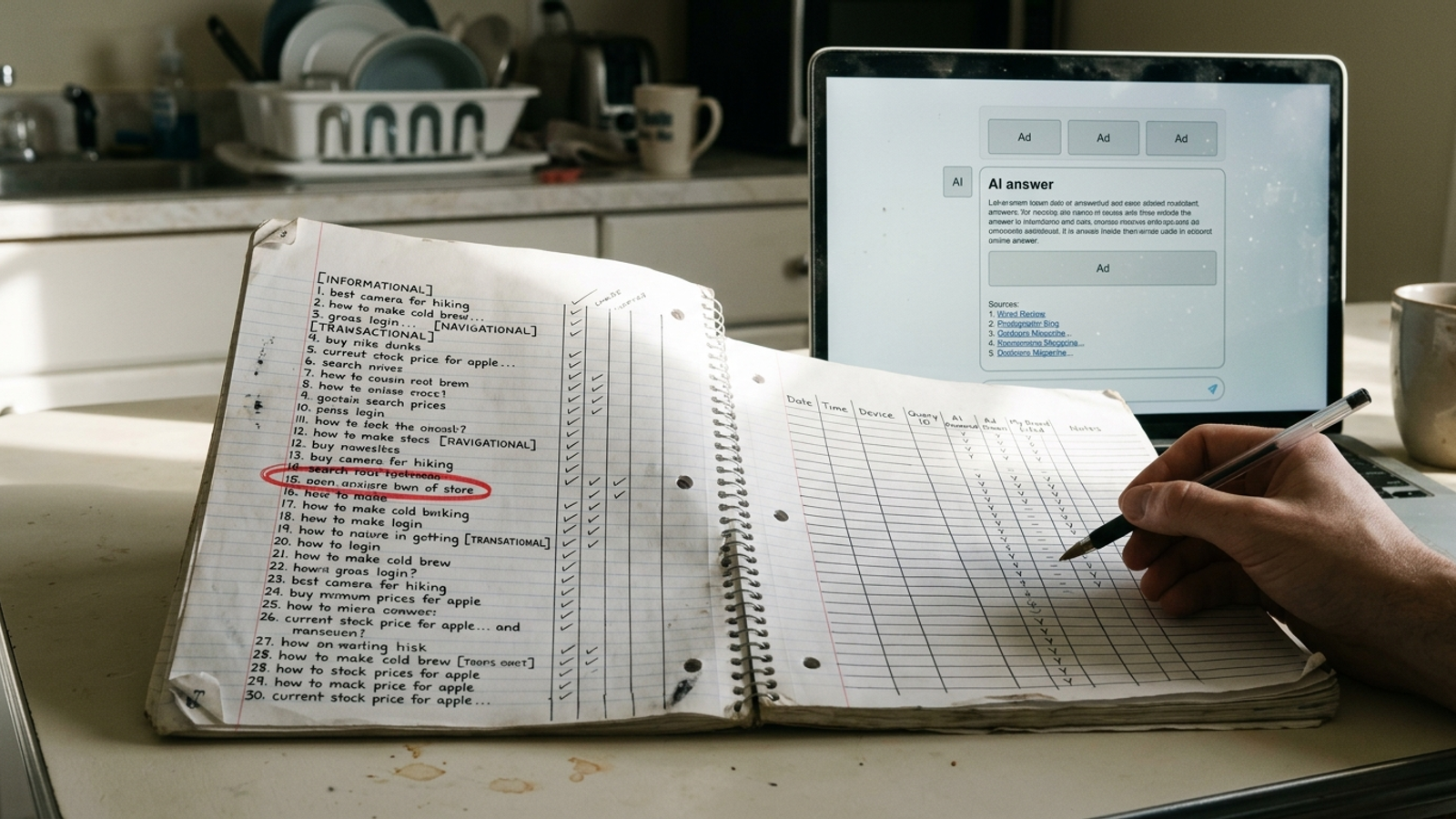
Use one row per query per check. Record six fields every time:
- Whether an AI Overview appeared: yes or no.
- Whether an ad appeared above, below or inside the Overview. Leave the position blank if no relevant ad appeared.
- The advertiser’s name, if an ad appeared.
- The cited sources, in the order shown.
- Whether your domain was cited.
- Which competitor was cited instead of you, if any.
That last field is easy to skip. Do not. If the same two competitors occupy the citations across your commercial bucket, you have something more useful than a general complaint about Google: two pages to examine.
Keep the inside position distinct from ads above or below the box. Those are three different positions relative to an Overview, and the sponsored recommendation embedded in the summary is highly selective: one 25,000-SERP scan found it at around 0.052% frequency. It is live in English in the US on mobile and desktop, but it must match the answer content, not merely the query. Google also applies commercial-intent, ad-inventory and Overview-relevance gates before the normal auction factors come into play. Lumping a top ad together with an in-answer placement will make a rare event look routine.
Take a two-week baseline before editing a page
Check the full set twice a week for two weeks. Same conditions, same sheet. Do not react to the first run. Overviews appear and vanish, citations reorder, and an ad visible on Tuesday may be gone on Friday. The measurement guidance is to follow a fixed sample weekly for four or more weeks, not to treat one snapshot as a verdict. Your two-week baseline is a starting pattern, not a final answer.
Watch for pages you rank for that never get cited. Overviews do not simply pick page-one results in order. They split a query into sub-questions and assemble an answer from pages that address them, so ranking first does not guarantee a citation. In a May 2026 study of 55,393 trending queries, 29.8% of cited domains were absent from the co-displayed page-one organic results. If a lower-ranking competitor keeps getting cited while you do not, do not dismiss the observation because your rank tracker looks healthy.
Date each check. Mark queries with no Overview rather than treating them as failed citations; there was no cited set to enter. Then leave the pages alone until the baseline is complete. The point is to know what moved after you intervened.
Change one page element and keep a control
Choose three to five pages targeting queries where you are not being cited but the same competitor repeatedly is. Match them to a set of similar pages you will leave untouched. Change one thing across the edited group. If you rewrite the copy, change the layout and add a table all at once, you will not know which change mattered. That is not a test. It is a renovation with a spreadsheet attached.
Pick the intervention that fits the gap you found. Options include:
- A direct answer high on the page, with a self-contained 40-to-60-word passage under a question-shaped heading. Citation guides point to this format because the passage can stand on its own; it needs no special opt-in or markup.
- Clearer author and entity signals, if the page makes it hard to tell who is speaking.
- One quotable number the answer can reuse, such as a price range, timeline or specification already supported by the page.
- A compact comparison table, if the competitor’s cited page has one and yours does not.
These are alternatives to test, not a checklist to apply to every page. Date the edits in the sheet and leave the controls untouched for four weeks. If an unrelated page change becomes unavoidable, note it. The control group is what lets you ask whether the edit helped, rather than congratulating yourself for a citation that might have appeared anyway.
Re-check after four weeks and score by intent
Continue checking the frozen query set under the same conditions for four weeks after the edit. Compare the edited pages with their controls, and break the results out by intent bucket. Score four things:
- Citation rate: when an Overview appeared, how often was your domain cited before and after the edit? Compare the edited group with the untouched group.
- Citation order: when you appeared, where did your source sit in the cited set?
- Ad presence: what share of Overviews carried an ad, in any position, on commercial queries versus informational ones?
- Business proxies: what happened to clicks and conversions for edited pages versus controls in Search Console and analytics? Compare like periods or weekly rates rather than setting two weeks of baseline totals against four weeks of follow-up totals.
Expect the click picture to be messy. Search Console does not isolate Overview clicks as a distinct source, and GA4 provides no distinct referral for them. Coverage, citation share and business proxies tracked over time will tell you more than a pretend-clean attribution number.
My expectation is that the edited pages pick up citations on question-form queries first, because those queries trigger Overviews more often than head terms. Pure commercial pages may move slower. Score by bucket or that pattern disappears inside one unhelpful average.
The click math explains why the test deserves space beside your paid report. Ahrefs found position-one CTR 58% lower when an Overview appeared in its February 2026 re-run, versus 34.5% in the prior April. A Seer longitudinal study of 3,119 informational queries found organic CTR falling from 1.76% to 0.61% and paid CTR from 19.7% to 6.34%. In the same answer, cited brands earned 35% more organic clicks and 91% more paid clicks than non-cited brands. Those differences do not prove the citation caused the clicks. They do show why citation rate belongs next to CPA, not in a separate SEO slide nobody opens.
Let the result choose the next move
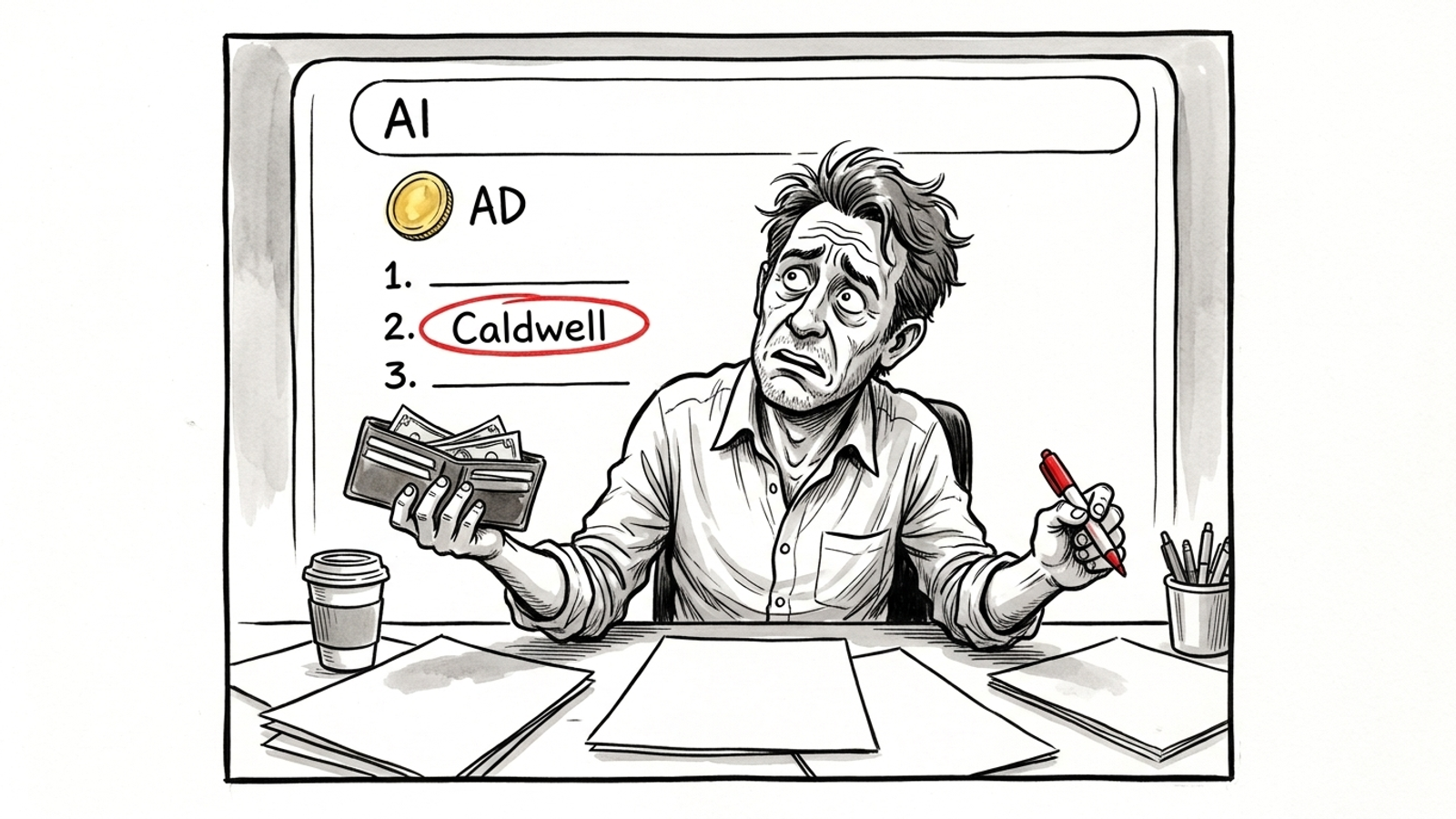
Ads are common and you are cited. Defend the page that made it into the answer: keep its passage current, fast and crawlable, and do not rewrite it for style points. Then test whether buying the adjacent placement adds clicks or pays for people who would have clicked your citation anyway. Use a geo or schedule holdout on, say, $20k/month spend. Do not use a feeling.
Ads are common and you are not cited. Do not raise bids yet. A higher bid may buy a more expensive click beside an answer that names someone else. Work on the sub-question the Overview answers, test the passage, table or number that your competitor’s page supplies, and re-check against the controls. My rule from managing accounts by hand: earn the mention first, then decide what the click is worth. For more on that control-group discipline, see The 30-Day Citation Test.
Ads are rare. If fewer than one in five of your money queries produces an ad near an Overview, paid placement is not the immediate problem this test has found. Keep testing the passages and tables that might earn citations. Leave your controls untouched through the measurement period, then re-run the sheet next quarter. A quiet category can get louder; there is no prize for adjusting bids against an ad that seldom appears.
Results are noisy or mixed. Perhaps two edited pages gain citations and three do not, or the control moves too. That is what a small sample can look like. Extend the test to six to eight weeks before calling it. Keep the query list frozen and ask whether the winners share a pattern: question phrasing, comparison tables or pages with usable numbers. If the edits beat the controls in one bucket and tie elsewhere, you have a place to investigate. You do not have a universal rule.
Put the same queries back on the bench next quarter
Run the full check once a quarter: same list, same conditions, same fields. Compare ad presence by intent, your citation rate and the competitors appearing in your place. That comparison decides whether you work on the citation, buy the placement or do both.
Doing the checks by hand for a quarter is manageable. Doing them continuously while also managing bids, budgets, search terms and page changes is where manual work breaks down. That is why groas runs search work alongside paid search around the clock rather than treating optimization as an occasional spot check.
A forecast tells you where the market might go. Your sheet tells you what changed on the searches that matter to your business. If the citation edit works, defend it and test paid incrementality. If it does not, you have ruled out one intervention without spending more to advertise beside somebody else’s answer.