

 LinkedIn
The rocket on slide one is headed straight for your procurement budget. By slide three, the AI Overview Domination Package has sold you a $6,000 FAQ schema install; by slide seven, it has explained why you must wait nine months to find out whether it worked.
I have marked up the onboarding deck below. The vendor copy is in italics. My notes are not. If you are buying help getting cited in AI Overviews, ask for a page, a query and a dated change before you buy a score.
Slide 1: Congratulations on Choosing Generative Dominance
Dear Valued Partner, welcome to your AI Overview Domination Package. Our platform monitors 18,000 buyer prompts across 8 engines and has already improved Generative Visibility for 900+ brands.
My note: count the verbs. Monitors. Improved. Neither tells me who got cited, for which query, or what happened to pipeline. The deck has room for 18,000 prompts but not one example of a buyer reaching a useful answer. That is an impressive allocation of slide space.
I used to treat visibility as a leading indicator. It can be one. But when the vendor defines visibility, chooses the prompts and reports the score, I want to see the underlying citations before I call the graph progress. A mention is not a citation, and a citation is not revenue. Make the vendor show the steps between them.
Slide 2: The Visibility Index™ Is Green
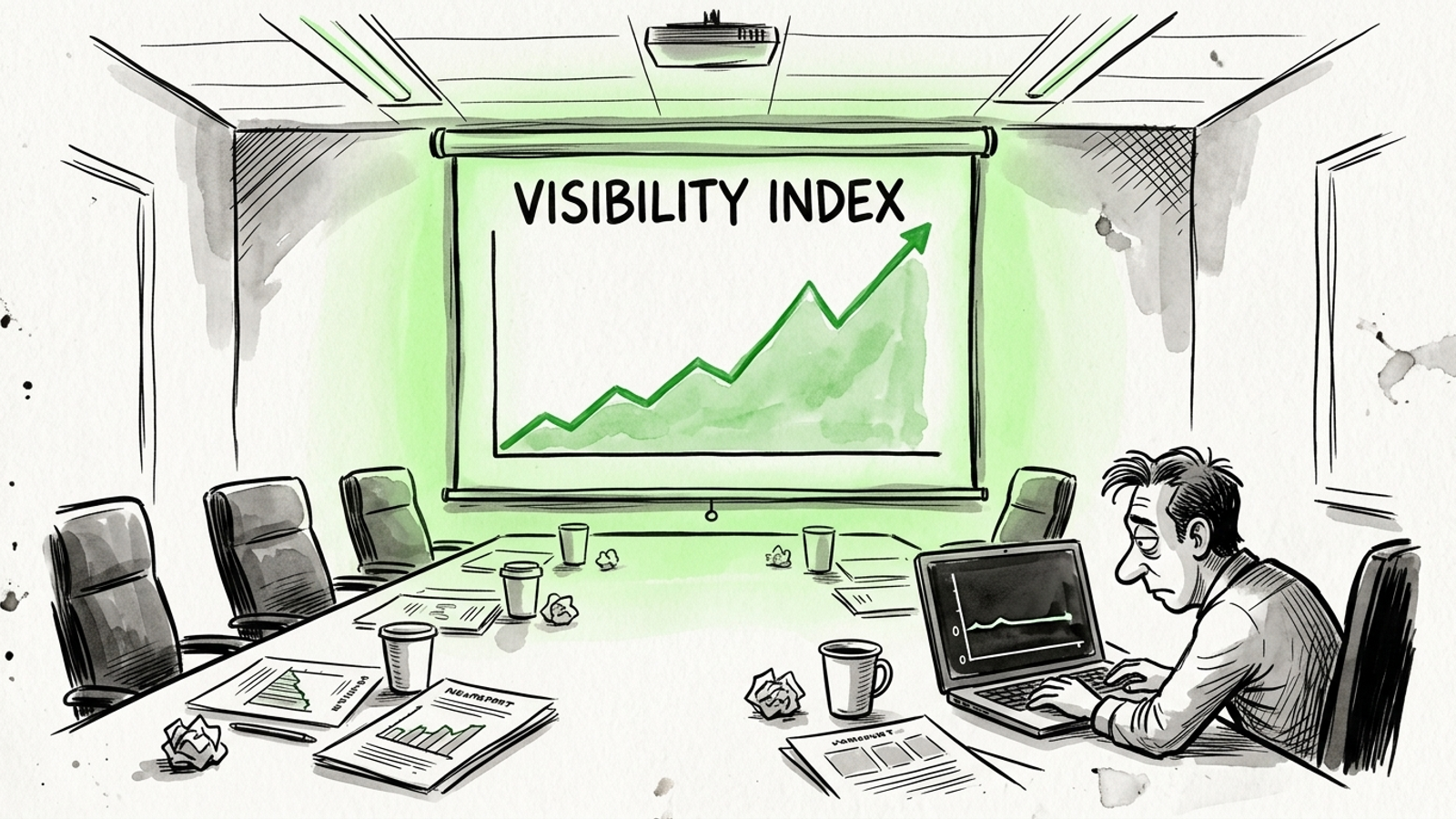
Your Generative Visibility Score rose from 34 to 61 this month. Our sentiment-weighted model tracks mentions across thousands of prompts. Green means dominant.
My note: I love a proprietary score. You cannot audit its weighting, and the slide does not say whether any of those prompts reflect buying intent. One analyst team called these scores vanity metrics for exactly that reason: answers change by prompt and by person, there is no platform-reported volume, and in their client data 44% of real prompts already contained the brand name.
That last number is awkward for the chart. If someone asks an engine about your brand by name, a brand mention is hardly evidence that the vendor created demand. Separate those prompts from unbranded questions before announcing a victory. Then show the answer, the citation and the query that produced each one. A green score cannot tell you which of those things happened.
Slide 3: Phase One, FAQ Schema on Every Page Including the 404
For a one-time implementation fee of $6,000 plus $1,200 per month for monitoring, we will deploy FAQ schema sitewide. This tells Google your content is LLM-ready.
My note: I know why this sells. It is a defined task with a completion date, a reassuring technical name and a tidy implementation fee. The problem is the leap from we installed markup to Google will cite us.
Google says no special markup is required for AI Overviews or AI Mode: a page needs to be indexed and eligible for a snippet, while schema can remove ambiguity. It does not force a citation or rescue a vague answer. In one test, Ahrefs added JSON-LD to 1,885 pages against 4,000 controls and found +2.4% on AI Mode, +2.2% on ChatGPT and -4.6% on Overviews, all indistinguishable from zero.
Keep schema where it serves a purpose, including rich results. Do not buy a sitewide install as a citation strategy. The invoice proves that the markup shipped, not that an answer improved. Ask to see the page the vendor plans to make useful first.
Slide 4: Our Proprietary LLM-Ready Landing Page Template
Each page gets our LLM-Optimized badge, a conversational hero, and a chatbot widget so Google knows the page speaks AI.
My note: the badge is a small blue checkmark in the footer. The answer is still buried in paragraph nine under three sliders. I would rather move the answer than decorate the footer, but that makes for a less photogenic product slide.
Guides that test citation patterns keep landing on the same structure: a question-shaped H2, followed high on the page by a direct 40-to-60-word answer. Resolve the pronouns inside that block so it still makes sense when quoted alone. If the passage begins this helps them achieve better results, it needs the paragraph above it to explain who them refers to and what this does. That is a poor candidate for a standalone answer.
The hero can still sell. It just cannot do the job of the answer. We deliver innovative solutions for modern teams gives a reader nothing to use and an engine little to quote. Rewrite the first 80 words around the actual query, with plain nouns, then put the sales copy below. Give the page a passage worth lifting before you give it a badge.
Slide 5: The According-to-Experts Content Protocol
Our strategists will insert trust phrases such as according to experts, research shows and highly recommended across your site. LLMs are trained to respect authoritative language.
My note: the phrase according to experts works best when the next words identify an expert and something that expert actually said. Otherwise it is best-in-class in a lab coat. Repeating it across the site does not make the underlying claim easier to check.
One analysis of 30 million citations found Reddit at 21% of Google AI Overview citations, ahead of YouTube and Quora, with Wikipedia at only 5.7%. That does not mean every business needs a Reddit campaign. It does mean the deck’s obsession with polishing its client’s own pages leaves out a large part of where answers find supporting material. On commercial queries, a discussion about the category may say more than a vendor homepage does.
Off-site corroboration beats on-site adjectives. A price, turnaround time or limitation is more useful when a forum answer, video or partner page can describe it accurately too. I would rather see one detailed answer somewhere the business does not control than 47 instances of according to experts on pages it does. Delete the trust phrases. State facts that another source can confirm, then give people a reason to repeat them.
The deck’s running total: $6,000 in schema, one blue badge, 47 trust phrases. Its citation log has not appeared.
Slide 6: Monthly Reporting, Now With More Screenshots
Pages 28 to 35: 14 screenshots of your brand mentioned in answers to prompts such as best plumber-style service for someone who values quality. Sentiment: positive. Share of voice: up.
My note: screenshots show what the answer said at a moment in time. They do not show whether the prompt matters to a buyer, whether the answer cited a useful page or whether the report found every relevant query. I want those distinctions made before anyone circles positive in green.
Ahrefs looked at 1.9 million citations in July 2025 and found 76.1% of cited pages ranked in the top 10 for the same query. It ran the test again in March 2026 on 863,000 SERPs and 4 million URLs and found only 37.9% in the top 10, with 31% beyond position 100. The explanation was fan-out queries: an answer can cite a page that ranks for a related sub-question rather than the exact prompt you typed.
That makes a familiar ranking chart a shaky substitute for citation reporting. Your homepage can rank first while the answer draws on a different page for a buyer’s specific question. Conversely, a relevant citation can come from a page the homepage chart ignores. For each screenshot, ask what prompt produced it, what page was cited and whether a buyer would ask that question. Keep the screenshot; stop asking it to do the whole report’s job.
Slide 7: Why Results Take 9 to 12 Months (Renewal Is Auto)
AI trust compounds slowly. Our enterprise protocol requires 9 to 12 months of content velocity and authority signals. Your annual renewal is already scheduled.
My note: some content and off-site work takes time. That does not mean the first test needs nine months, and content velocity is not an answer to which page changes next. At this point I want a work order, not another curve climbing toward the upper right.
What vendors sell at this tier is measurement plus labor: software at $99 to about $650 per month flags absence and scores citability, while agency retainers run about $1,500 to $5,000 for small firms and $10,000 to $30,000 plus for enterprise audits, rewrites and digital PR. Some of that work matters. The price does not tell you which part the vendor will perform, or how you will inspect it.
Pick one page and one query. Rewrite the answer block, fix crawl issues, wait three weeks and check the citation. That is a test, not a promise of a citation on day 21. If nothing appears, you still have a dated record of what changed and a reason to decide what to try next. If the vendor cannot name the first page and query, the timeline is protecting the retainer, not the test.
Slide 8: Procurement Appendix (Complete Before Payment)
Please confirm your alignment with our Generative Visibility Framework. Your signature indicates acceptance of the reporting cadence and scheduled renewal.
My note: I would set down the pen and ask these in order. The answers should fit beside the vendor’s proposed work, not in another 42-slide deck. Leave the last question until they have shown you the plan; it is the one the polished reports tend to skip.
- Which page, which buyer query and by what date? Name one URL and one query to work on first. A promise to improve your presence is not a work order.
- Can you show a citation that was not there before? Ask for the query, the cited page and before-and-after dates. A screenshot of a brand mention does not establish the change.
- How do you separate branded prompts from unbranded ones? If a prompt already contains the brand name, report it separately rather than folding it into evidence of newly earned visibility.
- What happens if nothing is cited after 30 days? Ask what gets inspected or changed next. Wait until month nine is a renewal schedule, not a diagnosis.
- What did you change on the page and off the site? Ask for the answer-block edit, any crawl fix and any third-party mention, each tied to the page and query. Skip this and you can pay the whole fee for a score while the answer remains buried and nobody else corroborates it.
Slide 9: Your First Deliverable Is Not a Dashboard
Our team will now activate your citation-readiness workflow and begin generating monthly insights.
My note: translate activate into work on one page. Choose a buyer query and a relevant service or product URL, not the homepage by default. Put a question-shaped H2 near the top and answer it in two to four sentences. Use the price, geography, turnaround time or specification that makes the answer specific, where that detail belongs. Make the passage stand alone. Then make sure the page is indexable and the answer is accessible in clean HTML rather than trapped behind a slider.
After that, look beyond the site. A partner page, review or listing that states the same concrete detail gives the claim another place to be checked. I walk through the page-level work in how to get cited in Google AI Overviews, and the off-site half in why ChatGPT never mentions you. Recheck the actual AI Overview for the chosen query, logged out, on mobile and desktop. Record the date and whether the page is cited. One page, one query, three weeks of observable work: that is a more useful first deliverable than a Visibility Index with a pleasing color scheme.
Thank you for partnering with us on your journey to Generative Dominance. Your next report will arrive before your renewal notice.
My final margin note: ask for the log of pages changed and third-party mentions earned. Redirect the next round of work to the one-page test. Keep the writer who can produce a clean answer; pause the schema tickets that exist only to fill a task list. groas runs search work continuously, with changes logged and tied to queries rather than bundled into a monthly screenshot pack. No badge, no trust phrases, no nine-month story standing in for a first test.
Citations come from answer-first passages, crawlable pages and off-site corroboration, not from rituals. The deck is funny until it auto-renews.