

 LinkedIn
I spent nine years writing ad copy to a character limit, and that discipline is better training for AI Overviews than most SEO checklists: answer one query in the first sentence, back it with a specific number, and stop. A passage such as “Etsy charges 6.5% transaction + processing” gives an answer engine something it can lift; “fees can be kind of high” does not.
Copy blocks for the page
1. Put the answer before the pitch
Use it at the top of a landing page when you want the answer quoted. Only 38% of cited pages also ranked in the top 10, down from 76% in July 2025. A ranking helps, but a passage still has to stand on its own.
[Question as your H2, e.g.: How much does bookkeeping cost for a 10-person agency?]

[One-sentence answer with number, e.g.: Bookkeeping for a 10-person agency costs $495 per month at [Brand], reconciled weekly, with month-end close by the 5th business day.]
[Second sentence with scope limit, e.g.: This covers up to 300 transactions per month and excludes payroll filing.]
One adjustment: Put the number in the first 60 words. I used to bury pricing in paragraph three because someone told me to “build value first.” I was wrong. The answer cannot be lifted whole if the reader has to dig for it.
2. Define one thing, not three
Use it when the query starts with what is, how does, or what does. Give the term a category, a job and an audience. One claim per sentence, supported by a specific number, is easier to reuse than a paragraph of hedging.
[Term] is [category] that [does X] for [who].
Example: A conversion tracking audit is a 27-point check that confirms which Google Ads conversions fire, which duplicate, and which import into Smart Bidding.
It takes [timeframe] and you get [deliverable].
Example: It takes 3 business days and you get a fixed list of keep, fix, or remove for every conversion action.
One adjustment: Kill the second definition. If two terms need defining, give each its own block. The reader came for one answer, not a glossary that escaped its enclosure.
3. State the price so nobody has to guess
Use it on a service or product page where vague “starting at” copy could leave the model guessing. If you spend $20k a month on ads, a price without its unit or scope is not much of an answer.
[Product or plan] costs $[number] per [month / user / project], including [2 inclusions max].
[If pricing uses a different structure, state the fee and unit plainly.]
Example: The Paid Ads Sprint costs a flat fee per 90-day sprint, with the +40% sales target in writing before you pay. No percentage of spend, no setup fee.
Price last verified [Month Year].
One adjustment: Add the verified-date line, and supply the actual amount wherever the page states a fixed price. A date tells the reader when the figure was checked; it does not rescue a sentence that omits the figure.
4. Give the comparison a verdict
Use it when buyers search best, vs, or top 5. Comparison pages pack more facts into a small space; cited pages cover 31% more facts on average, and 55% of citations come from the first 30% of page content. Put the verdict table in the first 200 words.
| If you need | Pick | Why in one line |
|---|---|---|
| [Need 1, e.g. management that acts daily] | [Option A] | [Specific reason and number, e.g. bids and budgets worked around the clock] |
| [Need 2, e.g. reporting only] | [Option B] | [Specific limit, e.g. weekly check-ins; you implement] |

Verdict: For [query], pick [Option A] because [one-number reason].
One adjustment: Put one checkable fact in each cell. A table full of adjectives makes the buyer do the comparison you were supposed to do. The verdict should follow from the cells, not arrive like a surprise guest.
5. Make the FAQ visible before marking it up
Use it for three follow-up questions buyers ask after the main answer. Put the answers on the page, then match any FAQPage schema to the visible wording. FAQPage no longer produces Google rich results after the August 2023 restriction and 2026 removal, though it remains valid schema.org. Treat the markup as a description of the copy, not a substitute for it.
## [Question-shaped H2, e.g.: How long until changes show in AI Overviews?]

**Q: Do I need llms.txt to be cited in Google AI Overviews?**
A: No. Your page needs to be indexed and eligible for a snippet. No special markup or llms.txt is required.

**Q: Will blocking Google-Extended remove me from AI Overviews?**
A: No. Blocking Google-Extended does not remove the page from AI Overviews.

**Q: How fast do robots.txt changes take for ChatGPT Search?**
A: About 24 hours after OAI-SearchBot can fetch the file.
{
  "@context": "https://schema.org",
  "@type": "FAQPage",
  "mainEntity": [{
    "@type": "Question",
    "name": "Do I need llms.txt to be cited in Google AI Overviews?",
    "acceptedAnswer": {"@type": "Answer", "text": "No. Your page needs to be indexed and eligible for a snippet. No special markup or llms.txt is required."}
  }]
}
One adjustment: Keep Answer.text in plain text and identical to the visible answer. If you change the page copy, change the markup too. Two versions of the same answer are one version too many.
6. Say who should leave
Use it wherever you make a strong product claim. A clean skip line filters bad-fit buyers before they cost you CPA and gives an answer engine a useful negative statement. What the deck calls “objection handling,” I call telling people not to buy.
Who should skip [Product]:
- Skip if [condition 1, e.g. you spend under $5k/month and change copy weekly yourself].
- Skip if [condition 2, e.g. you need a dashboard, not someone to act in the account].
- Pick [Product] if [condition, e.g. you want bids, budgets and landing pages worked daily against a CPA target].
One adjustment: Name the actual tradeoff. Being cited does not guarantee being recommended; the cited page can still point an answer toward a competitor. Make it easy to tell who your product fits better.
7. Put the measurement beside the claim
Use it directly under a promise. Numbers give buyers something to assess, but a result without its measurement method is just a louder adjective. Cited brands earn about 120% more organic clicks per impression and 91% higher paid CTR than uncited competitors, so a quoted claim should be worth clicking through to check.
[Result] in [timeframe] for [who, no name needed]: [metric before] to [metric after].
Example format: Conversion rate up 51% and CPA down 27% in three weeks for a home-services account at the same spend.
How measured: [source, e.g. Google Ads conversion tracking, audited against CRM].
One adjustment: Add the how measured sentence. I used to write the result and stop. If the method matters to believing the number, make the reader hunt for neither.
8. Identify who stands behind the page
Use it at the bottom of a money page. An author, review date and stable description of the business tell the reader who is speaking. Anonymous copy leaves them to work that out for themselves.
Written by [Name], [Role, e.g. PPC operator, 9 years managing Google Ads].
Reviewed [Month Year]. [Brand] is [one-line entity, e.g. a fully autonomous growth engine for paid and organic search].
Contact: [email or about URL].
One adjustment: Keep the entity sentence consistent across pages. If you describe the same company five different ways, you make a simple identification task harder than it needs to be.
Technical blocks for access and attribution
9. Separate training crawlers from answer crawlers
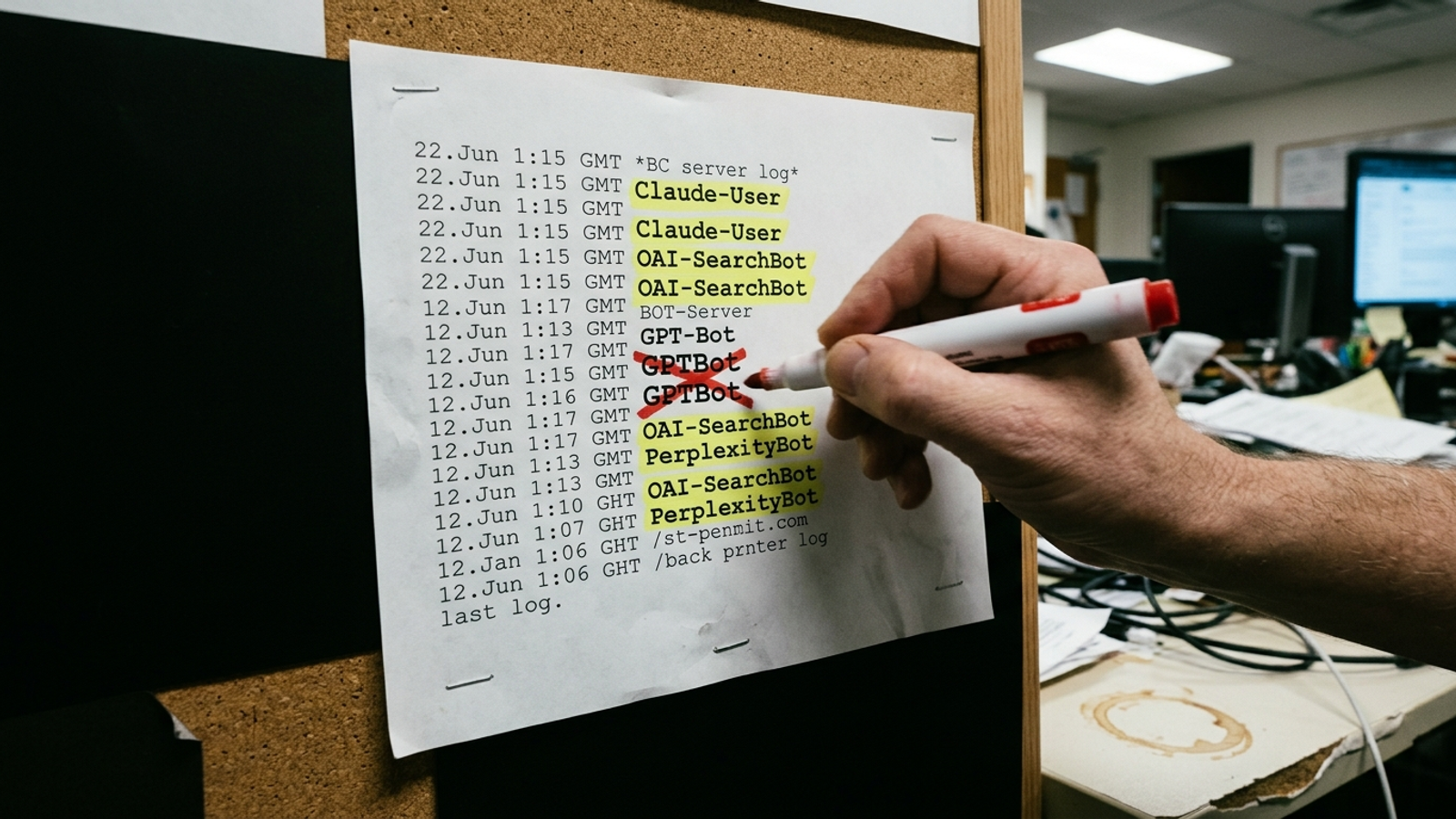
Use it when you want to restrict the listed training crawlers without blocking the listed agents used for search and answers. Training and answer crawlers have different roles; for ChatGPT, OAI-SearchBot controls search visibility while GPTBot is training-only. I see sites block everything, then wonder why nothing gets quoted.
# Block listed training crawlers; allow listed answer crawlers
User-agent: GPTBot
Disallow: /

User-agent: ClaudeBot
Disallow: /

User-agent: CCBot
Disallow: /

User-agent: Google-Extended
Disallow: /

User-agent: Applebot-Extended
Disallow: /

User-agent: OAI-SearchBot
Allow: /

User-agent: ChatGPT-User
Allow: /

User-agent: Claude-SearchBot
Allow: /

User-agent: Claude-User
Allow: /

User-agent: PerplexityBot
Allow: /

User-agent: Perplexity-User
Allow: /
One adjustment: Check that Claude-User and ChatGPT-User remain allowed if live answers are the goal. Answer bots such as Claude-User fetch robots.txt. Blocking access can prevent a fetch; allowing it does not promise a citation.
10. Match structured data to the visible offer
Use it to identify the business and describe a product whose details appear on the page. Schema will not get the page cited on its own. It should give the same brand and price as the copy a buyer can read.
{
  "@context": "https://schema.org",
  "@type": "Organization",
  "name": "[Brand]",
  "url": "[https://example.com]",
  "logo": "[https://example.com/logo.png]"
}
{
  "@context": "https://schema.org",
  "@type": "Product",
  "name": "[Product]",
  "brand": {"@type": "Brand", "name": "[Brand]"},
  "offers": {"@type": "Offer", "price": "[495]", "priceCurrency": "[USD]"}
}
One adjustment: Match the Product price to the visible pricing sentence in Block 3. If the page says one number and the markup says another, fix the disagreement before asking an answer engine to interpret it.
11. Give llms.txt clickable destinations
Use it as a roadmap at /llms.txt for the pages you want an answer engine to find. The proposed file format uses Markdown links, and the Lighthouse Agentic Browsing check fails a file without text links. It is a map, not a citation switch.
# [Brand]
> [One line: what you do and for whom. E.g.: Fully autonomous growth engine for paid and organic search for businesses spending $5k+/month.]

## Best pages
- [Pricing and scope: what is included](https://example.com/pricing): flat fee, scope limits, verified date.
- [Comparison: Option A vs Option B](https://example.com/compare): verdict table with numbers.
- [FAQ: timelines and requirements](https://example.com/faq): matched visible copy and schema.

## Contact
- [About and contact](https://example.com/about): author, entity, email.
One adjustment: Keep each destination in text form with a short description after the colon. A bare URL gives the reader less reason to follow it and fails the linked-page check described above.
12. Link the fact, not the brand name
Use it to connect the answer, its price, its method and its limits. Each anchor should tell the reader what they will find at the destination. No guessing, no click here.
- [how long until changes show in AI Overviews](https://example.com/faq#timing) from the opener to the FAQ.
- [flat-fee pricing verified in March 2026](https://example.com/pricing) from the comparison verdict to the pricing sentence.
- [conversion tracking audit method](https://example.com/method) from every proof line to the definition block.
- [who should skip this plan](https://example.com/pricing#skip) from the pricing page to the skip block.
One adjustment: Point the anchor at the page that holds the fact, and update dated wording when the fact is rechecked. Flat-fee pricing verified in March 2026 carries information. Click here carries none.
The check before another rewrite
Use it after publishing a block, before declaring it a winner or a loser. Search Console groups AI Overview and AI Mode clicks under Web search rather than a separate citation report. A monitor can sell you a score; I would rather use the same panel of 20 to 30 prompts each month in Google and ChatGPT and record what was actually cited.
[Prompt] | [Date] | [Google: cited / not cited] | [ChatGPT: cited / not cited] | [Cited URL]
[Prompt] | [Date] | [Google: cited / not cited] | [ChatGPT: cited / not cited] | [Cited URL]

Also check: utm_source=chatgpt.com referrals in analytics; OAI-SearchBot fetches in server logs.
Decision date: [Six weeks after the first check].
One adjustment: Record the cited URL, not just a brand mention. AI can cite a domain without naming the brand; one analysis puts link-only citations at 62% and cases with both link and mention at 13.2%. If you count names alone, you miss the ghost citations. Run the same prompts for six weeks before you call a block a loser.
Use this next check when an indexed page shows zero pickups after that run. AI Overviews cite about nine unique domains per answer, a figure reported as stable since Q4 2025. Another sentence rewrite is not the only lever. I rate tools that help you get featured in Google AI Overviews, not just monitored by whether they fix technical blockers, publish missing facts and log what changed. That is what groas does on my accounts: it runs paid and organic execution around the clock and logs actions with reasoning, instead of handing me a 60-page audit to implement myself.
Before rewriting again, check:
- [Can the relevant answer crawler fetch the page?]
- [Does the page state the number and its scope visibly?]
- [Does it cover the question the prompt actually asks?]
- [What changed, and when?]
One adjustment: If the blocker is access, missing facts or coverage, fix that blocker. Do not buy a prettier monitoring report and call it execution.
The block I would keep
Use it when you have time to change only one passage. Block 1 forces the discipline behind the whole file: one query, one number, then the limit that keeps the answer honest.
[Question as your H2]

[Direct answer with one specific number in the first sentence.]
[One sentence defining what that number includes or excludes.]
One adjustment: Cut the lead-in. I used to tell clients to build toward the answer. I was wrong. Put the answer where a reader can find it in 40 words, date the price if there is one, and let the prompt panel tell you what happens next.